Spoken Into the Walls: The Living Memory That Died When the Pub Did
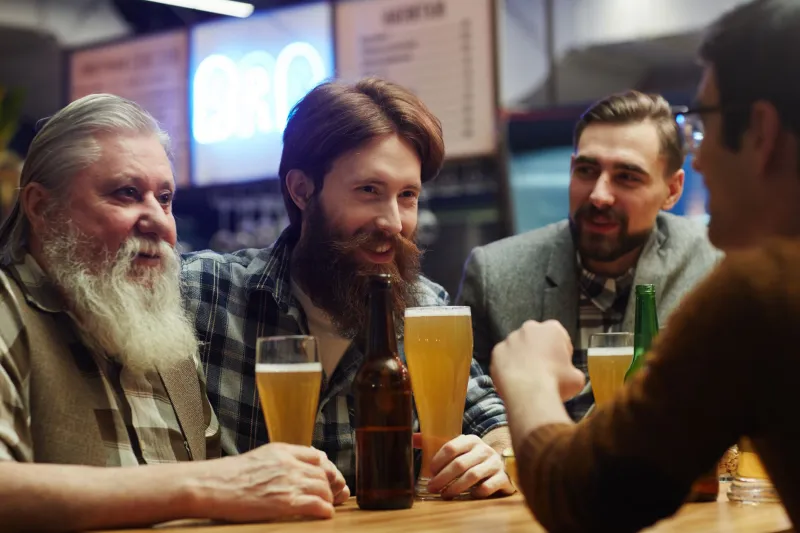
There's a particular kind of knowledge that can't be typed into a search bar. It doesn't live in the county archive or the local studies library, though those places matter too. It lived, for generations, in the Thursday night corner of a pub — passed from one regular to the next like a baton nobody officially handed over.
We called it gossip. We called it rambling. We called it old so-and-so going on again. What it actually was, though we'd never have used the phrase, was oral history. And now it's gone.
The Accidental Historians
Every pub had at least one. The bloke who'd lived on the same street for sixty years and could tell you, without prompting, that the newsagent's used to be a saddler's, that the road flooded every winter before the council put in drainage in 1971, that the family in the corner house had lost two sons in the same week in 1944. He wasn't showing off. He was just talking. That was the thing — nobody performed this knowledge. It came out naturally, embedded in conversation, woven into arguments about planning applications or complaints about the new one-way system.
The pub was the room where this happened. Not a library. Not a community centre. Not a church hall. The pub, specifically, because it combined the right ingredients: regular attendance, a relaxed atmosphere, alcohol in modest quantities, and the kind of unhurried time that lets a story breathe. You couldn't rush it. You couldn't schedule it. It came when it came, and if you were there, you caught it.
Local newspapers used to do some of this work too, of course. But even at their best, they printed what was verifiable, what was safe, what fitted a column inch. The pub had no such constraints. In the pub, you heard why the planning application really got rejected. You heard which councillor owed which developer a favour. You heard, in careful and specific detail, exactly what happened the night the landlord of the Anchor came to blows with the area manager from the brewery. None of it was on the record. All of it was true.
 Photo: the Anchor, via thumb-nss.xhcdn.com
Memory as Infrastructure
It's worth being precise about what's actually been lost here, because it's easy to romanticise and harder to be specific.
What the pub provided, functionally, was a distributed memory system. No single person held all of it. Old Arthur knew about the pre-war streets. Maureen knew every family that had ever rented from the same landlord because her mother had worked for him. Dave the plumber had been under every house on three roads and could tell you which ones had been bodged and when. None of them knew what the others knew. But together, in the same room, over many years, they formed something remarkable — a collective, living archive of a place.
This isn't sentiment. Historians and anthropologists have a name for it: community memory. It's the informal record that fills the gaps between official documents. It's how we know that the Victorian terrace on Caldwell Street was built six inches off the boundary line because the builder was bribed to look the other way. It's how we know the stream that used to run through what is now the retail park — the one the council concreted over in 1968 — was where half the town's children learned to fish. None of that is written anywhere. It existed only in the telling.
 Photo: Caldwell Street, via moveo.telepass.com
What Replaced It
The honest answer is: nothing adequate.
Local Facebook groups have a go. There's usually one — something like "Memories of [Town Name]" — where people post old photographs and argue about dates. It's not worthless. Some genuinely valuable material surfaces there. But it's also a pale shadow of what the pub provided, for reasons that aren't hard to identify.
For a start, Facebook captures what people choose to share publicly. The pub captured what people said in private. The distinction matters enormously. The real texture of a community's history — the uncomfortable bits, the shameful bits, the bits that reflect badly on people who still have living relatives — that rarely makes it onto a community Facebook group. It did, quietly, make it into pub conversation. Not to cause harm, but because it was part of the story.
For another thing, Facebook is asynchronous. You post, someone comments three days later, someone else contradicts them a week after that. The pub was live. One story sparked another, which sparked a correction, which sparked a clarification, which ended with everyone understanding something more completely than when they'd walked in. That chain reaction — the way one memory unlocks another — is irreplaceable in text.
The Evaporation
Here's the part that should genuinely trouble anyone who cares about communities: when a pub closes, the knowledge doesn't go anywhere. It doesn't migrate to another venue. It doesn't get written down in a last-minute rush. It evaporates.
The regulars scatter. Some move. Some die. Some just stop going out. The conversations that would have happened — the ones that would have passed on a particular story to a younger pair of ears — simply don't occur. The chain breaks. And once it breaks, it can't be repaired, because the people who held the knowledge are gone.
We've closed roughly a third of Britain's pubs since the turn of the millennium. That's not just a loss of buildings or businesses. It's a loss of archive. Every shuttered local represents a hole in the record — a neighbourhood whose specific, granular, human history will never now be recovered.
No algorithm is coming to fix this. No heritage lottery fund will restore it. The only thing that could have preserved it was the thing we let disappear: the room where people gathered, night after night, and talked.
What We Owe the Old Stories
There's a particular sadness in walking past a closed pub. Not just the boarded windows or the peeling paint. It's the knowledge of what was lost inside those walls — not the furniture or the fittings, but the thousands of hours of conversation that once filled the air. The arguments, the corrections, the half-remembered details that someone else confirmed. All of it gone.
Britain has always been a country that undervalues its informal culture. We preserve the stately homes and the battlefield sites, but we let the pubs close and think nothing of it. We don't notice, until it's too late, that we've demolished something that took generations to build — something that no amount of community consultation, neighbourhood planning, or digital heritage project can reconstruct.
The pub wasn't just a place to drink. It was the room where a community remembered itself. And we closed it down, one by one, and called it progress.