When Names Tell Stories: The Vanished Vocabularies of Britain's Lost Boozers
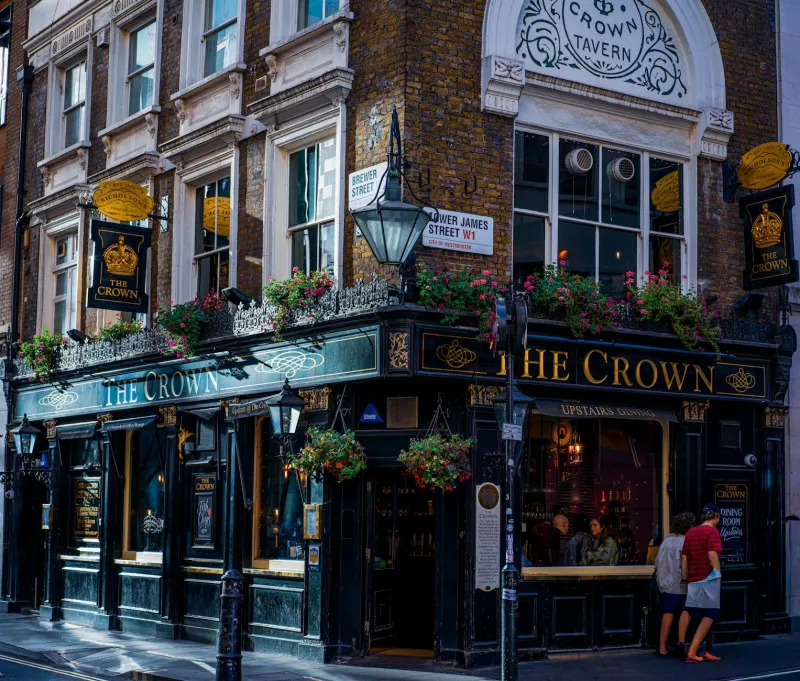
The Stories Written in Swinging Signs
Walk down any British high street today and you'll find yourself reading a different kind of story than your grandparents did. Where once The Wheatsheaf told you this was farming country, or The Anchor marked a riverside community, now you're more likely to encounter 'Serenity Wellness Studio' or 'Urban Bean Co.' The pub names that once served as Britain's most honest historians are vanishing, and with them, the living memory of who we were.
It's not just buildings we're losing—though God knows we're losing plenty of those. It's the entire vocabulary of place, the shorthand that connected us to centuries of neighbours who drank under the same signs, told the same stories, and understood without explanation why their local was called what it was called.
The Original Social Media
Pub names weren't chosen by marketing committees or focus groups. They evolved organically from the life of the community, becoming the original hashtags of British social life. The Red Lion marked loyalty to the crown, The Railway Tavern celebrated the iron horse's arrival, and The Cricketers told you where the village spent its summer Sundays.
These weren't just convenient labels—they were conversation starters, memory aids, and identity markers all rolled into one. "Meet me at The Plough" didn't just tell you where to go; it reminded you that this community grew from agricultural roots. "Down at The Forge" connected your Friday pint to the blacksmith who once kept the village moving.
The pub wasn't just a place to drink—it was the original social network, the living room for your neighbourhood. And the name above the door was like the family surname, carrying forward generations of shared experience.
Reading the Landscape Through Brass Plates
Britain's pub names once formed a comprehensive guide to local geography, industry, and culture. Coastal towns were dotted with Anchors, Ships, and Mariners' Arms. Mining communities gathered at The Colliers or The Miners' Rest. Market towns centred around The Bull, The Swan, or The White Hart—names that spoke to the livestock that built their prosperity.
Religious history lived on in The Cross Keys, The Lamb and Flag, and The Angel. Political allegiances were declared through The Crown, The King's Head, or The Duke of Wellington. Even local wildlife got its due in The Fox and Hounds, The Stag, or The Badger's Sett.
Each name was a page in the community's biography, written in a language everyone could read. Lose the pub, and you don't just lose a drinking establishment—you lose a chapter of local memory that can never be rewritten.
The Gentrification of Memory
What replaces these vanished vocabularies tells its own story, though it's not a particularly comforting one. The Wheatsheaf becomes 'Harvest Kitchen & Wine Bar.' The Railway Tavern transforms into 'Platform 9¾ Gastropub.' The authentic gives way to the themed, the organic to the manufactured.
Worse still are the complete erasures—the pub knocked down for flats that carry no memory of what came before. 'Riverside Apartments' might sit where The Ferryboat Inn once welcomed travellers, but the new name tells you nothing about the crossing point that shaped the community for centuries.
These aren't just aesthetic losses. When we lose The Blacksmith's Arms, we lose the collective memory that this corner once rang with hammer on anvil. When The Wool Pack disappears, so does the understanding that this high street once bustled with merchants trading the fleeces that built Britain's medieval wealth.
The Last Chapter
Perhaps most tragically, we're losing names faster than we're creating new ones. Modern pubs, when they do appear, often sport generic titles designed by branding agencies rather than earned through community life. 'The Slug & Lettuce' or 'All Bar One' could be anywhere, belonging to everywhere and nowhere.
The old names grew from the soil of their communities like the hops in their beer. They couldn't be transplanted or franchised because they were inseparable from place and time. The Fighting Cocks in St Albans claims to be England's oldest pub, but it's not just the building that's ancient—it's the name that connects today's drinkers to a thousand years of locals who understood exactly what those words meant.
When we lose these names, we lose more than signage. We lose the ability to read our own history in the landscape, to understand how our communities grew and what sustained them. We're left with a countryside as generic as a shopping centre, where every corner could be any corner and nothing quite belongs.
The pub wasn't just Britain's living room—it was our memory palace, and the names above the doors were the keys to every room. Now we're throwing away those keys, one demolished boozer at a time, and wondering why everywhere feels the same.