The Accidental Friend: How the Pub Made Connections No Algorithm Ever Could
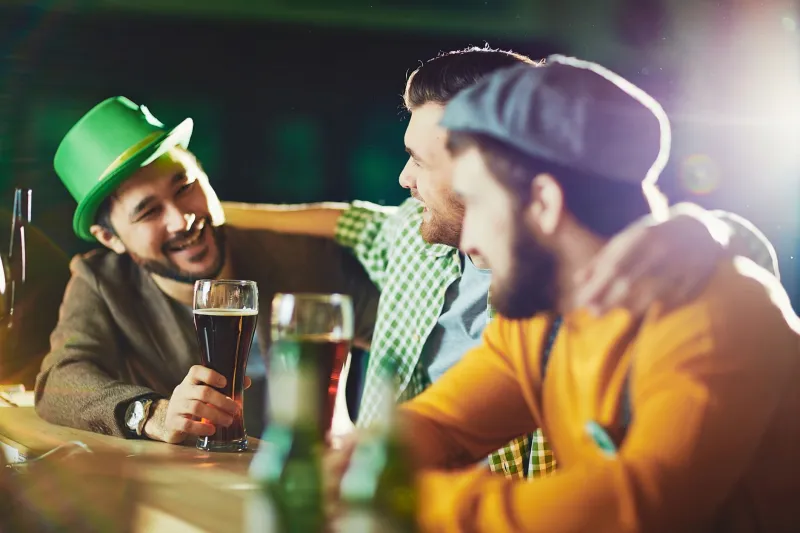
Let me tell you about a friendship that shouldn't exist.
My uncle — a secondary school history teacher, mildly left-leaning, holder of strong opinions about the correct way to make a pot of tea — became, in his late thirties, close friends with a man who ran a roofing company, voted differently, had no patience for formal education, and thought a proper cup of tea came from a bag dunked for thirty seconds. They met in the lounge bar of a pub in Wolverhampton in 1987. They were placed next to each other by geography and chance. They are still friends today.
Neither of them would have found the other on any app. No algorithm would have matched them. Their profiles — interests, politics, backgrounds, vocabularies — pointed in opposite directions. The pub didn't care. The pub just put them in the same room and let time do the rest.
The Sociology of the Barstool
Sociologists have a term for the kind of connection my uncle made that evening: a weak tie. Unlike strong ties — the deep bonds with close family and best friends — weak ties are the looser relationships with acquaintances, neighbours, and people you know just well enough to nod at. For decades, researchers assumed strong ties were the ones that mattered. Then they looked more carefully.
It turns out weak ties are, in many ways, more valuable. They expose you to information, opportunities, and perspectives that your close circle — which tends to look and think like you — can't provide. Weak ties are how most people find jobs, hear about opportunities, and encounter ideas that genuinely challenge them. Strong ties reinforce who you are. Weak ties expand it.
The British pub was, without knowing the terminology, the greatest weak-tie generator in human history. It threw together people who had no particular reason to speak to each other and gave them the conditions — a little warmth, a little time, a socially acceptable lubricant — to do so anyway.
Geography as Destiny
The key mechanism was geography. You didn't choose your pub the way you choose a Facebook group or a subreddit. You went to the pub that was nearest, or the one your dad went to, or the one on the way home from work. The selection process was almost entirely spatial. And because it was spatial, it was diverse in ways that self-selection never is.
Your local pulled in the retired teacher and the plasterer's apprentice, the district nurse finishing a long shift and the market trader who'd been up since four. It contained pensioners who remembered rationing and teenagers who'd never known a world without mobile phones. None of them had curated each other. They'd simply ended up in the same postcode.
This is precisely what modern social platforms cannot replicate, no matter how sophisticated their matching becomes. Every algorithm optimises for similarity. The more it learns about you, the more it shows you people who already share your tastes, your politics, your cultural references. It's comfortable. It's also a slow narrowing.
The pub did the opposite. It optimised for nothing. It just opened the door.
What You Learned from People Unlike You
Think about what actually happens in a conversation between two people who have no particular reason to agree. At first, there's friction — different assumptions, different frames of reference, different ways of arriving at a point. But if the environment is relaxed enough, and the time is long enough, something shifts. You stop assuming the other person is wrong and start getting curious about why they think what they think.
This is the social education the pub provided, quietly and without fanfare, across generations. It taught people to hold a conversation with someone who saw the world differently, and to find that interesting rather than threatening. That skill — genuinely underrated, genuinely disappearing — required regular practice with actual strangers. The pub supplied those strangers on a weekly basis.
Group chats don't do this. They're almost always formed around prior connection — a family, a workplace, a shared interest. The people in your WhatsApp groups are people you already know, or already resemble. There's no mechanism for the accidental introduction, no equivalent of being placed next to someone at the bar and running out of ways to avoid conversation.
The Loneliness Paradox
Britain is, by most measures, lonelier than it has ever been. We are more connected — in the technological sense — than any previous generation, and more isolated in every meaningful one. Loneliness rates have risen steadily for decades. Mental health services are overwhelmed. People report having fewer close friends, fewer trusted confidants, fewer people they could call in a crisis.
And yet we act as though the platforms designed to connect us are basically adequate substitutes for the real thing. They are not. They are not even close.
The pub, at its best, was a standing appointment with the full range of humanity. It didn't ask you to be interesting or photogenic or algorithmically legible. It just asked you to show up. The belonging it generated was a byproduct of presence, not performance.
Derek, the retired postman, the roofing contractor, the nurse on her second glass of wine — they weren't carefully selected companions. They were the people who happened to be there. And that, it turns out, was exactly the point.
We replaced the accident with the algorithm and called it progress. The loneliness statistics suggest otherwise.