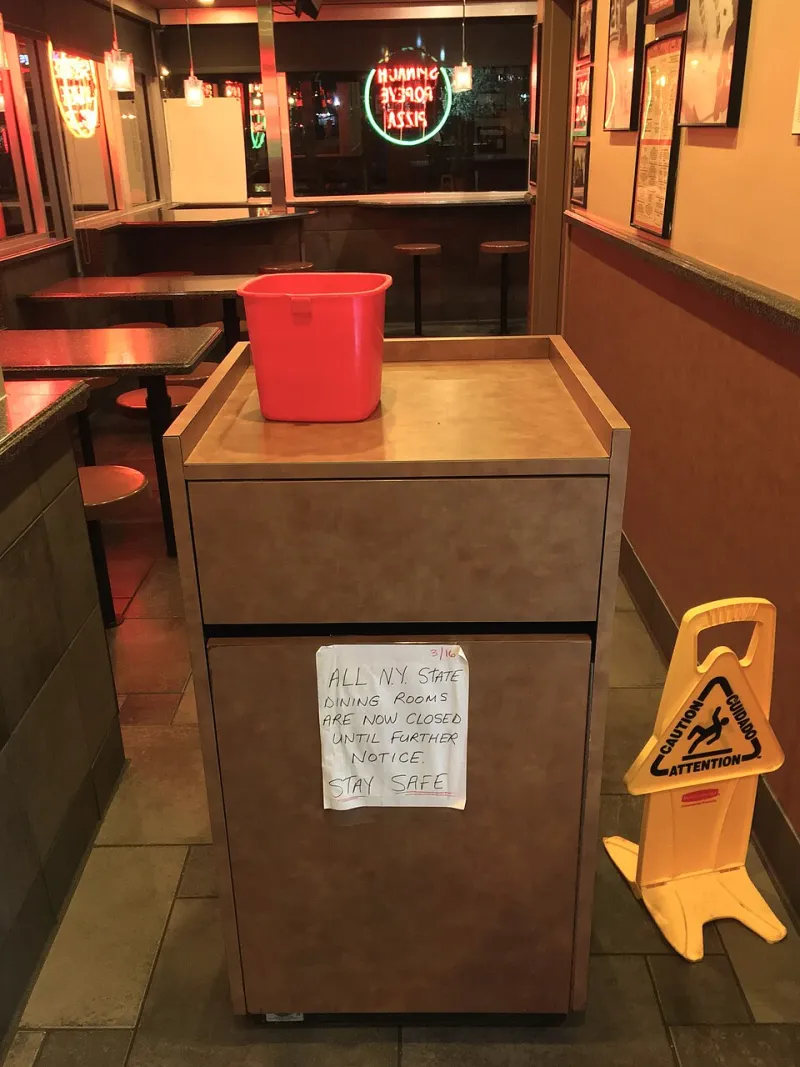
Photo: Andre Carrotflower, CC BY-SA 4.0, via Wikimedia Commons
It was never laminated. It was rarely typed. Often it was written on the back of a delivery note, or a torn sheet from a reporter's pad, or — in the finest tradition of British improvisation — the inside of a cereal box flattened out and turned over. The handwriting was sometimes neat, sometimes barely legible, occasionally in two different pens because the first one had run out halfway through.
And yet it told you everything you needed to know.
Closed Tuesday — family matter. Back Wednesday as normal. Sorry for the inconvenience.
Meat draw this Friday, 7pm. All welcome.
Private function Saturday evening. Bar open from 9.
Five words. Ten words. Rarely more than thirty. Stuck to the inside of the front window with a strip of Sellotape that had usually gone amber with age.
The handwritten pub sign was Britain's most honest form of communication, and we let it vanish without a second thought.
The Sign That Knew You
Here's what made it different from everything that replaced it: the sign was written for a specific audience. Not for followers, not for an algorithm's idea of your demographic, not for anyone who happened to search the right postcode. It was written for the people who walked past that particular window on that particular street.
The landlord knew who those people were. He knew the retired postman who passed at half eight every morning. He knew the women from the factory who came in on Fridays. He knew which regulars would be disappointed to find the bar closed, and which ones needed fair warning that Saturday night would be noisy. The sign was addressed to all of them, personally, even though it named none of them.
That specificity — that intimate knowledge of a walking, breathing audience — is something no social media post has ever achieved. When a pub puts something on Facebook now, it's broadcasting into a void, hoping the algorithm delivers it to someone who might care. When the landlord taped a note to his window in 1987, he knew exactly who was going to read it before the ink was dry.
What the Signs Actually Said
The content was never glamorous. Pub window signs didn't announce exciting new cocktail menus or the arrival of a guest chef from somewhere fashionable. They announced the ordinary rhythms of a community life.
A wake on Thursday. A retirement do for someone who'd worked at the same place for forty years. A collection for a family who'd had a bad time of it. The quiz postponed because the quizmaster was in hospital. The darts team meeting moved to Tuesday.
Read together, the signs that a single pub posted over the course of a year would tell you more about the neighbourhood than any council report or local newspaper ever managed. They were the minutes of an ongoing community meeting — informal, unedited, and entirely authentic.
There was also, if you knew how to read them, an emotional register that no press release could replicate. Closed today, sorry — written in slightly larger letters than usual, the biro pressed harder into the paper — could mean a dozen things. A bereavement. An emergency. A landlord who'd simply had enough for one day and needed the world to leave him alone. Regulars learned to read these nuances the way you learn to read the face of someone you've known for twenty years. The sign was a human document.
The Intimacy of Imperfection
The handwriting mattered. This is something worth dwelling on.
A typed notice is neutral. It could have come from anywhere. It carries no personality, no mood, no evidence of the human being who produced it. A handwritten sign, by contrast, is a minor act of self-revelation. You can tell when it was written in a hurry. You can tell when the person writing it was upset, or pleased, or simply distracted by something happening in the bar behind them.
One regular from a pub in West Yorkshire once described to me how she'd always known when the landlady was under pressure because her window signs became smaller and more cramped, the letters compressed as though she was trying to take up less space. When things were good, the writing opened out, the letters generous and unhurried. Nobody had told this regular to look for these signs. She'd simply learned to read them, the way you learn to read anyone you care about.
 Photo: West Yorkshire, via sdvh.co.uk
This is what we traded away for a Facebook event page.
The Announcement That Stopped You in Your Tracks
Perhaps the most powerful thing a pub window sign could do was catch you by surprise. You weren't looking for it. You were walking past on your way somewhere else, head down, thinking about whatever you were thinking about, and then something in your peripheral vision made you stop.
You stepped closer. You read the sign. And in that moment, you were connected — to the pub, to the street, to the small dramas of a community you were part of whether you'd consciously chosen to be or not.
That interruption was a gift. It reminded you that you lived somewhere specific, among specific people, whose lives intersected with yours in ways that mattered. The sign that announced a neighbour's retirement party, or a collection for a local family, or simply that the pub would be closed on Christmas Day so the staff could spend it with their own families — each of these was a small, insistent reminder that you belonged to something larger than yourself.
Scroll past a social media post and you're a consumer making a choice. Stop at a pub window and you're a neighbour, whether you like it or not.
Gone, But Not Replaced
The handwritten sign didn't disappear because something better came along. It disappeared because the pubs that produced it disappeared, or changed into something that no longer felt the need to speak directly to its street. The gastropub with the QR code menu doesn't write notes to its neighbourhood. It doesn't know its neighbourhood well enough to bother.
What remains, in the windows of the pubs that still exist, is usually a printed A4 sheet in a plastic sleeve, or nothing at all. Occasionally a chalkboard sign outside, carefully designed to look artless — the craft beer equivalent of a handwritten sign, without the handwriting or the craft.
The real thing is gone. And with it went a small but genuine form of intimacy: the proof that a building on your street actually knew you were there.