Pinned to the Wall: The Faded Photographs That Knew Every Face in the Room
There was always one corner of the pub where the photographs lived. Not a gallery, exactly — nothing so grand. More of a gradual accumulation. A Polaroid from last year's Christmas do, slightly off-centre. A team photograph from the darts league, 1987, everyone squinting against a flash. A snapshot of the landlord's retirement party at his previous place, brought along when he moved and never quite taken down. Over the years, these things multiplied, overlapping at the edges, held up by a single drawing pin doing the work of three.
If you were a regular, you knew every face in those photographs. If you were new, you spent your first few visits quietly studying them, learning the history of the room before anyone had bothered to tell you.
A Portrait Gallery That Nobody Planned
Britain has always had a complicated relationship with portraiture. The National Portrait Gallery celebrates the famous, the powerful, the historically significant. What it has never celebrated — what no official institution ever thought to celebrate — is the face of the man who won the meat raffle three weeks running, or the woman who organised every fundraiser from 1974 to 2001 without once being asked to stop.
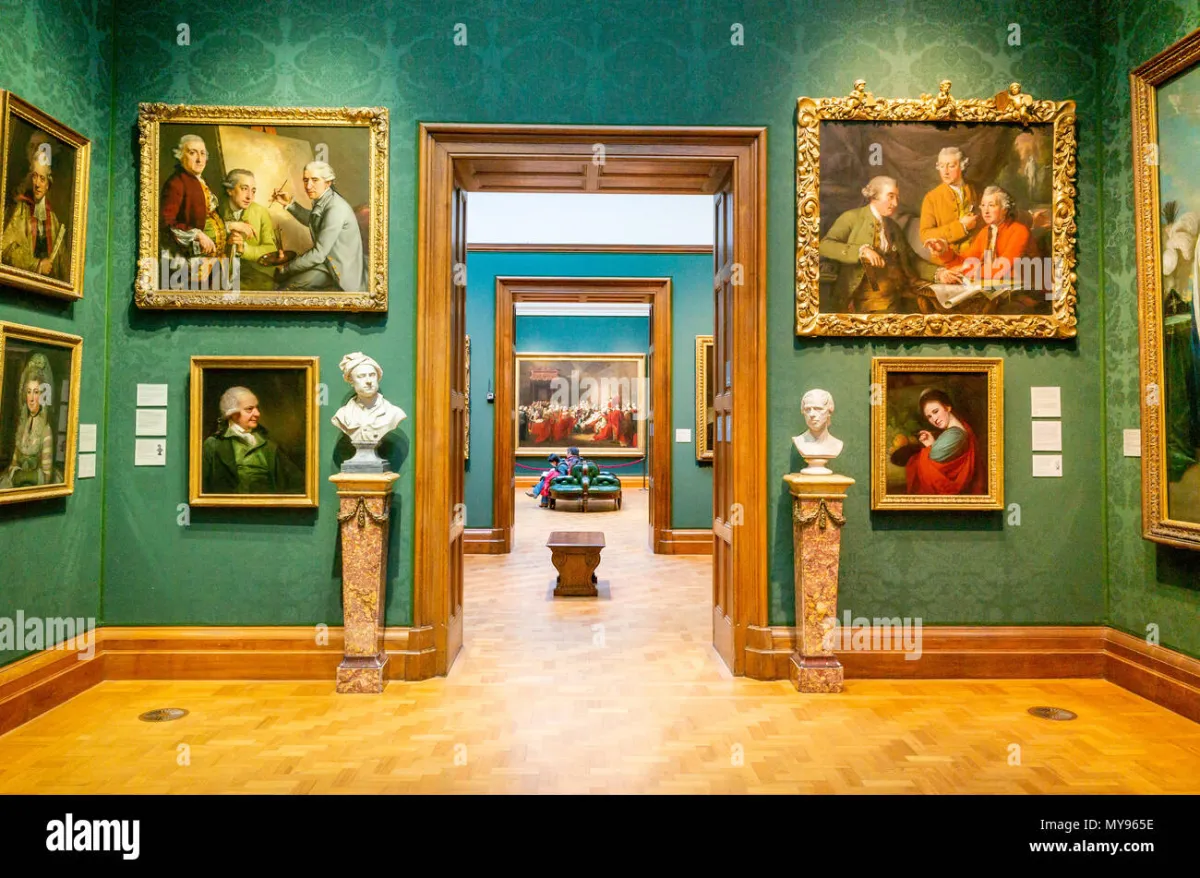 Photo: National Portrait Gallery, via c8.alamy.com
The pub wall did that job instead. Quietly, without any curatorial intention, it assembled a portrait gallery of ordinary life. Not the great and the good. Not the historically significant. Just the people who showed up, week after week, and made a community out of showing up.
Local photographers — often someone's nephew, or a regular who'd bought himself a decent camera — would turn up on darts nights or New Year's Eve, take a roll of film, and hand the prints to the landlord a week later. The landlord would pin them up somewhere near the bar, usually without frames, usually without labels. Everyone knew who was who. That was the point.
What Those Images Actually Recorded
Look closely at any surviving pub photograph from the 1970s or 1980s and you'll see things that no formal record captures. The way a man holds his pint. The particular lean of someone who's been standing at the same spot for thirty years. The group photograph where half the people are laughing at something that happened a split second before the shutter clicked, and the other half haven't caught up yet.
These images documented not just faces but postures, relationships, hierarchies. You could tell who was whose best mate, who was on the outs with whom, who had just arrived and who had been there since the doors opened. Social historians would kill for material this honest. Instead, most of it ended up in a bin liner when the pub changed hands.
The official archives of British working-class life are patchy at best. Parish records, census data, the occasional factory photograph. What they almost entirely lack is any sense of what leisure actually looked like — how people held themselves when they were relaxed, what they wore on a Friday night, what they looked like when they were genuinely happy rather than posing for something important.
The pub wall filled that gap, entirely by accident, for about a century.
The Democratic Lens
There's something quietly radical about the pub photograph when you consider it properly. It asked nothing of its subjects. You didn't need to be famous. You didn't need to have achieved anything. You just needed to have been there, to have been part of the room on a particular evening, and the photograph would hold your place in history as faithfully as it held anyone else's.
In that sense, the pub wall was more democratic than any portrait commission, more honest than any official record. It treated the bloke who swept the car park with the same visual respect as the bloke who owned the brewery. Both faces, pinned at the same height, fading at the same rate.
We've replaced all of this with social media, of course. Everyone has photographs now — thousands of them, stored in clouds, sorted by algorithm, occasionally liked by people who weren't there. But the pub photograph wasn't about storage or reach. It was about placement. About a face being put on a specific wall, in a specific room, where the people who knew that face would see it every time they came in. That's not documentation. That's belonging.
When the Pubs Closed, the Photographs Went With Them
Here's the part that should bother us more than it does. When a pub closes — and roughly ten thousand have closed in Britain over the past two decades — the contents are dispersed, sold, or thrown away. The optics go to auction. The furniture goes to a salvage yard. The photographs, more often than not, go in the skip.
Occasionally someone rescues them. Local history societies have done remarkable work gathering what they can, and a handful of dedicated individuals have spent years collecting pub photographs before they disappear entirely. But for every collection that's been saved, dozens more have gone. Faces that were part of a community for forty or fifty years, simply erased.
The people in those photographs — many of them elderly now, many of them gone — never asked to be remembered by posterity. They just asked to be part of their local. But in being part of their local, they created something that posterity should have wanted: an honest, unposed, democratic record of what British life actually looked like from the inside.
The Living Room Nobody Archived
We talk a great deal these days about community, about connection, about the things we've lost to screens and isolation and the general fragmentation of modern life. What we talk about less is the specific mechanisms through which community was maintained — the small, unremarkable rituals that kept people tethered to one another across years and decades.
The pub photograph was one of those mechanisms. Not because it was art. Not because it was historically significant. But because it put your face on a wall where your neighbours could see it, and in doing so, said something that no algorithm has ever managed to say convincingly: you are known here, and you matter to this room.
That's what we lost when the photographs came down. Not images. Acknowledgement.