The Stranger You Already Knew: When Pubs Made Bumping Into People an Art Form
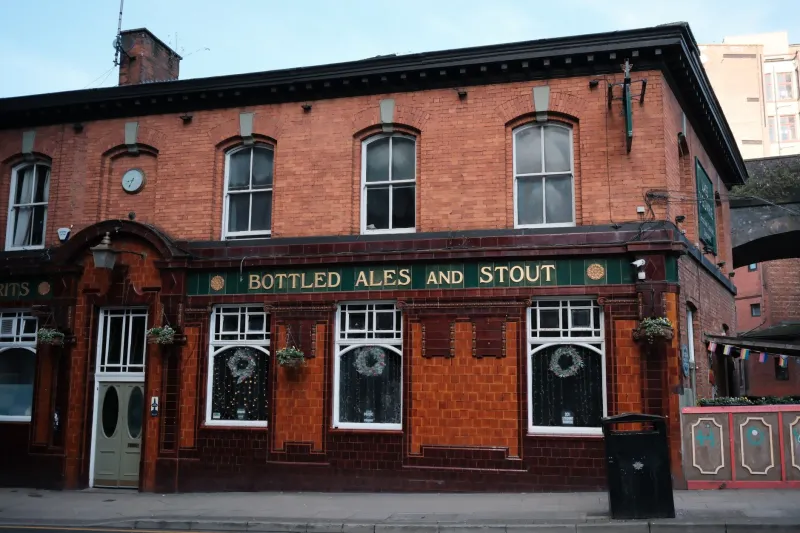
There's a particular kind of surprise that doesn't exist anymore. Not the planned surprise — the birthday party your wife spent three weeks organising — but the other kind. The unscripted, slightly giddy collision with someone you haven't thought about in years, standing at the same bar, reaching for the same bowl of pork scratchings. Bloody hell. How long has it been?
That moment. That one. It used to happen all the time.
The pub was, among its many other roles, Britain's greatest engine of accidental reunion. You didn't arrange to bump into people. You just did. And those unplanned encounters — chaotic, slightly awkward, occasionally life-changing — were quietly doing some of the most important social work in the country.
The Gravity of the Local
Every town, every village, every housing estate had its gravitational centre. The pub was it. Not the supermarket, not the leisure centre, not the school gates — the pub. It pulled people in from the surrounding streets with a kind of low-level inevitability. If you lived within a mile of The Red Lion or The Crown or The Wheatsheaf, sooner or later, you ended up inside it.
That geographic logic created something remarkable: a shared space where people from entirely different chapters of your life would occasionally and unexpectedly overlap. Your secondary school geography teacher and your old next-door neighbour and the bloke who used to service your dad's Ford Cortina — all of them orbiting the same sticky bar on a Saturday evening. The pub didn't care that you'd all moved on. It kept pulling you back into the same room.
And in that room, something happened. Threads got picked up. Old friendships that had quietly frayed were suddenly, briefly, re-stitched. You'd share a pint, exchange numbers you'd probably never use, and walk away feeling — not entirely logically — that the world was smaller and warmer than it had seemed on the way in.
What We've Traded It For
Ask yourself honestly: when did you last genuinely bump into someone from your past? Not arranged it, not reconnected via LinkedIn, not slid into their DMs — actually, physically encountered them by accident in a public space?
For most people, the honest answer is: not recently. Possibly years.
We've built extraordinarily sophisticated tools for staying in touch, and somehow ended up more isolated. You can follow an old schoolfriend's life in forensic detail — their holidays, their children, their opinions on the latest television drama — without ever being in the same room as them. The connection feels real. It isn't, quite. It's a performance of connection, carefully curated and fundamentally one-directional.
The accidental pub meeting was the opposite of that. It was unmanaged, unfiltered, and often uncomfortable in the best possible way. You couldn't control what version of yourself turned up, because you hadn't had time to prepare one. You just had to be a person, standing there with a pint, talking to another person. That rawness was the whole point.
The Serendipity Economy
Sociologists have a term for the value generated by unplanned social encounters: weak tie networks. The idea, developed by American sociologist Mark Granovetter back in the 1970s, is that the connections we maintain with acquaintances — people we know slightly, but not deeply — are often more socially and economically useful than our close friendships. It's the bloke you vaguely know from the pub who mentions a job going at his firm. The woman you once worked with who knows a good solicitor. The distant cousin who turns out to live three streets away and has a van.
Pubs were the infrastructure of weak tie networks. They kept those tenuous connections alive through regular, low-stakes, accidental contact. You didn't need to make an effort. The effort was built into the geography.
When the pub empties out at half eight on a Saturday, when the regulars stop coming, when the local closes and becomes a Tesco Express — that infrastructure collapses. And we notice it most keenly not in any grand, dramatic way, but in the quiet accumulation of people we've simply lost track of. People who drifted away because there was no longer a place that reliably pulled you both back into the same room.
The Closing of the Loop
There's a particular sadness to this that goes beyond nostalgia. It's not just that we miss the old days. It's that we've replaced a genuinely democratic, genuinely spontaneous social system with something that requires constant, conscious effort — and then wonder why maintaining friendships feels exhausting.
Keeping up with people used to be easy, because it was largely passive. You went to the pub. They went to the pub. You ended up in the same place. Now every connection requires scheduling, initiative, and the vaguely depressing process of finding a mutually convenient slot in two digital calendars.
The pub didn't just give you somewhere to drink. It gave you somewhere to accidentally remain part of each other's lives. That's what's gone. And the loss is bigger than most of us have properly reckoned with.
Somewhere out there is a face from your past you haven't seen in fifteen years. In a different Britain — a Britain with a functioning local on every corner — you'd have bumped into them by now. You'd have had a pint, caught up, perhaps made plans you'd half-keep.
Instead, you'll see their name pop up occasionally on your phone screen, and think: I really should message them. And then you won't, quite.