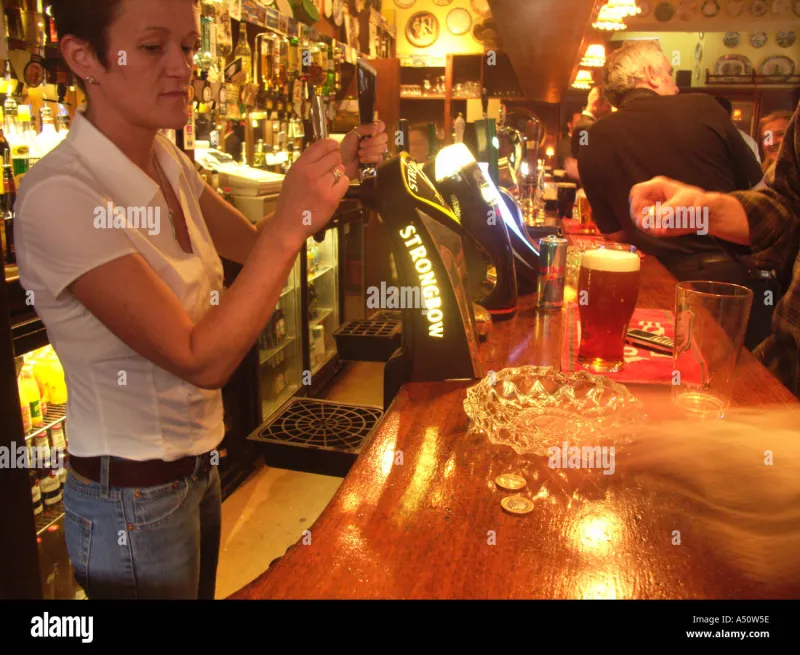
Photo: barmaid pulling pint for regular customer traditional British pub, via c8.alamy.com
Margaret had worked behind the bar at the same pub in Salford for nineteen years. She could tell you the usual of every regular in the place — not just the drink, but the glass, the temperature, the precise level of head that each person preferred — and she could begin pulling it the moment she saw a familiar silhouette through the frosted glass of the front door.
 Photo: Margaret, via c8.alamy.com
She never wrote any of it down. She never needed to.
'It's not about memory,' she told me once, wiping down the bar with the particular efficiency of someone who has performed the same motion ten thousand times. 'It's about paying attention. If you pay attention to people long enough, you just know them.'
That sentence has stayed with me. Because what Margaret was describing — what she practiced every shift, without fanfare or particular self-consciousness — was one of the most genuinely human things one person can do for another. She saw you. She anticipated you. She had your drink ready before you'd found your voice.
And we've let that disappear.
The Weight of a Usual
It's easy to underestimate what the 'usual' actually represented. On the surface, it's a simple convenience — you don't have to queue, you don't have to speak, your drink appears as though by a kind of benevolent magic. Nice, certainly. But hardly profound.
Except that it was profound, precisely because of what it required the other person to do.
To know someone's usual, you had to notice them. You had to watch how they drank, learn how their preferences shifted with the seasons or the mood, understand the difference between a man who wants his pint quickly because he's in a rush and a man who wants it quickly because he's had a rough day and needs the comfort of familiar ritual without delay. You had to be present, attentive, and genuinely interested in the specific human being in front of you — not as a customer, but as a person.
This is not a small thing. This is, in fact, extraordinarily rare.
Think about how many interactions you have in a week where another person demonstrates genuine prior knowledge of who you are and what you need. Your GP, if you're lucky. Your partner, on a good day. A close friend who's been paying attention. The list is not long. And yet, for generations of British men and women, the person behind the bar of their local was reliably on it.
The Landlord's Particular Gift
The great landlords and barmaids — and they were great, in the way that anyone who masters a genuinely difficult human skill is great — had a quality that's almost impossible to teach. They could hold dozens of usuals in their heads simultaneously, switching between them fluidly as the bar filled and emptied, never confusing one man's mild with another's bitter, never forgetting that the woman who always sat by the window had switched to halves after her doctor's appointment in October and hadn't switched back.
But more than mere recall, they had timing. They knew when to have the drink ready immediately and when to let a person settle first — to hang up their coat, exchange a word with whoever was nearest, decompress from whatever the day had thrown at them — before sliding the glass across the bar at precisely the right moment.
This timing was a form of emotional intelligence so finely calibrated it looked effortless. It wasn't. It was the product of years of careful observation, of learning to read the small signals — the set of a jaw, the pace of a walk, the particular way a man pushes through a door when he needs to forget something — that tell you what a person needs before they've worked it out themselves.
We used to call people like this barmaids and landlords. We should probably have called them something grander.
The Craft Beer Menu and the Art of Disappearing
The usual began to die before the pubs did. It started, perhaps, with the explosion of choice — the moment when a bar that had offered four options suddenly offered fourteen, and the landlord's encyclopedic knowledge of his regulars' preferences became practically impossible to maintain across an ever-shifting roster of seasonal ales and rotating guest taps.
This wasn't entirely the fault of craft beer, to be fair. The usual was already under pressure from the creeping transience of pub culture — the shift away from the true local, where the same faces appeared week after week, towards a more fluid model of occasional visiting, where familiarity was harder to build and therefore harder to maintain.
But the proliferation of choice accelerated something that was already happening. When a man who'd drunk the same bitter for thirty years found himself confronted with a chalkboard of unfamiliar names and ABV percentages, the landlord's quiet anticipation became impossible. You couldn't pull a usual if the usual itself was no longer certain.
And so people started ordering again. And the relationship changed.
Personalisation Without the Personal
Here's the particular cruelty of the present moment. We are told, constantly, that we live in an age of personalisation. Streaming services that know what you want to watch before you've decided. Retailers who anticipate your next purchase based on your last three. Algorithms that have mapped your preferences with a thoroughness no landlord could match.
And yet nobody feels known.
Because knowing, in the sense that Margaret practised it across nineteen years in Salford, is not the same as data. A machine that predicts your next order based on your previous behaviour has not seen you. It has processed you. There's no attention in it, no care, no genuine human interest in your wellbeing. It would serve you the same drink whether you were celebrating or grieving, whether you needed company or silence, whether you were the same person you were last Tuesday or someone entirely different.
Margaret would have known the difference. She'd have seen it in the way you walked through the door.
What It Felt Like
If you've experienced it, you'll know. There's a particular feeling — warm, slightly unsteady, like being caught off guard by something good — that comes from walking into a place and having someone demonstrate, without words, that they were expecting you.
The glass already on the bar. The pump still moving. A nod, unhurried, that says: yes, I know you, and I'm glad you're here.
It's not the drink. It was never really about the drink. It was about the proof, delivered in a small and daily ritual, that you existed in someone else's mind. That you had become, through the simple accumulation of presence and attention, a known quantity in at least one corner of the world.
That's what the usual gave you. And it's what we gave away, without quite realising what we were losing, in exchange for a world of infinite choice and no one who knows what you need.