Too Posh to Pull a Pint: How the Great British Local Priced Itself Out of Its Own Community
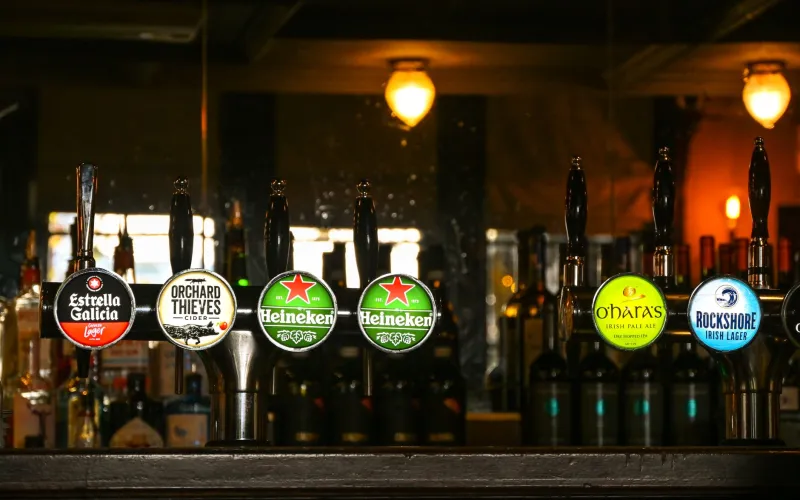
Let me describe two pubs for you.
The first one: sticky carpet, fruit machine chuntering in the corner, a chalkboard with three ales on and a menu that runs to scampi and chips, a Ploughman's, and a pie that arrives in a ceramic dish that's clearly been in use since 1987. The landlord knows your name. The bloke on the end stool has been sat there since approximately 1994. It smells of old wood and something that might be furniture polish and might just be time.
The second one: reclaimed timber floors, exposed brickwork, a beer list that runs to four laminated pages and includes something described as a 'hazy New England IPA with notes of mango and stone fruit.' The menu is a QR code. The bar staff are cheerful but don't know you from Adam. A round of drinks costs the same as a tank of petrol.
One of those pubs is a community. The other one is a hospitality concept. And over the last twenty years, we've been systematically replacing the first with the second, and calling it an improvement.
The Gastropub Takeover
The gastropub arrived in the 1990s and was, in principle, a reasonable idea. Better food, better wine, smarter surroundings. Nobody was arguing against a decent Sunday roast. The problem wasn't the ambition. It was what got quietly sacrificed in the pursuit of it.
When a pub starts optimising for Instagram content and Tripadvisor reviews, it stops optimising for the bloke who just wants a quiet pint after his shift. The lighting changes. The seating changes — suddenly it's all high stools and communal tables, which are wonderful for groups of friends who've already arranged to meet and actively hostile to anyone who just wandered in alone. The prices change. The atmosphere changes, in ways that are hard to articulate but immediately felt by anyone who grew up in a proper local.
The message, never stated explicitly but communicated clearly enough, is: this isn't really for you anymore.
The Craft Beer Paradox
Craft beer deserves particular scrutiny here, because it arrived with the language of authenticity and community — small breweries, local ingredients, passionate makers — and delivered something that often felt like the opposite.
Walk into a craft beer bar and you'll find a menu that requires a degree in brewing to navigate, prices that start at around six pounds a pint, and an atmosphere of mild connoisseurship that can make ordering feel like a test you might fail. The old pub was radically democratic: you asked for a pint of bitter, you got a pint of bitter, and nobody made you feel anything about it. The craft beer revolution, for all its genuine enthusiasm, introduced hierarchy into an institution that had spent centuries carefully avoiding it.
And the irony is rich. The people most likely to be priced and atmospherically excluded from the new-look craft pub are precisely the people whose grandfathers built the brewing traditions that craft beer claims to celebrate.
What a Proper Local Actually Did
Here's what gets lost in all the talk of premium experiences and elevated offerings: the neighbourhood pub wasn't just a place to drink. It was a leveller. A place where the factory worker and the factory manager might end up at the same bar, talking about the match, with no particular awareness of the distance between them.
That democratic quality wasn't accidental. It was structural. The low prices meant everyone could afford to be there. The lack of a dress code meant no one was excluded on appearance. The familiar layout — bar, stools, tables, fruit machine — meant you knew the rules before you walked in. There was no performance required. You just showed up.
The gastropub and the craft beer bar require a performance. You need to know how to read the menu, what questions to ask, how to behave in the space. That's a class signal, even when it's not intended as one. And the people who feel most immediately at home in those spaces are rarely the people who used to call the old local their living room.
The Numbers Don't Lie
Britain has lost tens of thousands of pubs in the last two decades. The closures cluster heavily in working-class communities — former mining towns, post-industrial estates, outer urban areas — while gastropubs and craft beer venues proliferate in city centres and wealthy suburbs. This isn't a coincidence. It's a market doing exactly what markets do: following money to where money already is.
The communities left behind don't just lose a drinking venue. They lose a meeting place, a notice board, a first-aid station for the soul. They lose the institution that held the loose threads of neighbourhood life together. And when someone proposes replacing the shuttered local with yet another coffee shop or co-working space, they're missing the point so comprehensively it would be funny if it weren't so bleak.
The Honest Question
If your pub has a tasting notes menu, a no-children-after-eight policy, and a cocktail list that takes twenty minutes to read, it is not a local. It is a restaurant that serves beer. That's fine, as far as it goes. But let's not pretend it's filling the hole left by the places it replaced.
The best pubs in British history weren't the fanciest ones. They were the ones where everyone felt, without having to think about it, that they belonged. That quality — that unspoken welcome — is what we surrendered on the altar of premium positioning. And no amount of hazy IPA is going to bring it back.