Bitter and Gone: How Britain Quietly Decided Who Deserves a Local
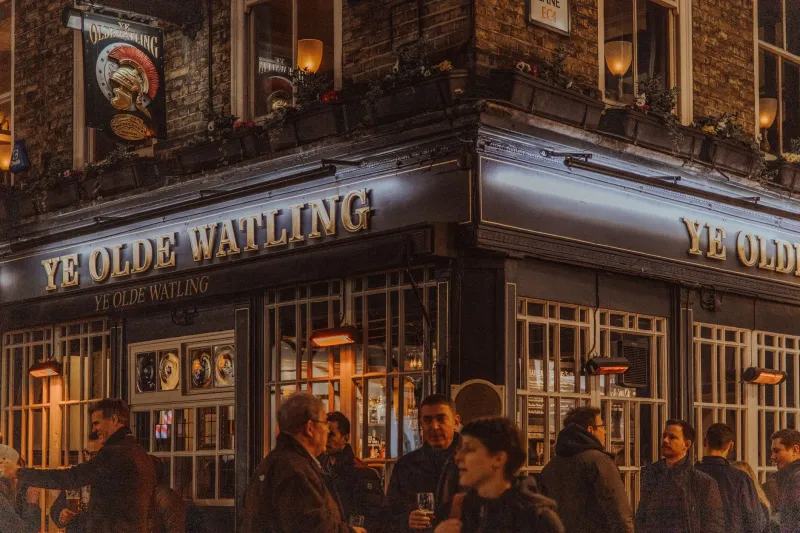
Let's be honest about something that tends to get lost in the elegiac writing about lost pubs, including on sites like this one. When we mourn the closure of a traditional British local, we're not mourning a neutral space. We're mourning a specifically working-class institution — one that was built by and for people who worked with their hands, who lived in terraced streets, who didn't have drawing rooms or dinner parties or anywhere else to go when they needed company. The pub was their living room because, in many cases, it was the only living room they had.
And the people who are replacing those pubs — not closing them, but transforming them into something else entirely — are not, by and large, the same people who used them.
The Gastropub Takeover
Walk through any town or city in England and you'll see the pattern repeated with the regularity of a planning decision. A traditional local, often with a name that's been on the sign for eighty years, closes. The building sits empty for a year or two. Then it reopens — stripped back, repainted in a muted heritage colour, the carpet ripped out and the floorboards sanded, the handpumps replaced by an artisan lager tap and a wine list that starts at seven pounds a glass.
The food is good, frequently excellent. The staff are friendly and knowledgeable. The atmosphere is pleasant in a carefully considered way. And the people sitting at the reclaimed-wood tables are, almost without exception, not the people who used to drink there.
This isn't accidental. It's the market functioning exactly as intended, reallocating a resource from a lower-value use (serving the local working-class community) to a higher-value one (serving the professional middle class who've moved into the area and want somewhere to eat on a Friday). The economics are straightforward. The social consequences are less discussed.
Who Gets to Have a Local?
The pub, at its best, was one of the few genuinely democratic spaces in British public life. You could be a dustman or a doctor, a factory hand or a foreman, and you'd sit at the same bar, drink the same beer, and be subject to the same social rules. Class existed, obviously — Britain has never pretended otherwise — but the pub had a way of suspending it, at least partially, at least for the duration of a round.
The gastropub and the wine bar don't work like that. They're not designed to. Their pricing, their aesthetic, their entire cultural register signals who belongs and who doesn't as clearly as any dress code. The man in the high-vis jacket finishing a shift doesn't walk into a place where the cheapest drink is a six-pound craft pale ale and feel that he's welcome, even if nobody says a word to him. He knows. The room tells him.
So he goes home. Or he drives to the out-of-town pub that still does a pint for three-fifty and a plate of scampi, if such a place still exists within reasonable distance. Or, increasingly, he just doesn't bother, because the effort of finding somewhere that feels like it's for him has become greater than the reward.
The Geography of Disappearance
The closures are not evenly distributed, and this matters. The pubs that have closed in the greatest numbers are not in prosperous market towns or gentrifying city neighbourhoods where a replacement quickly appears. They're in post-industrial communities, in coastal towns that never recovered from the end of manufacturing, in council estates and ex-mining villages where there was never a wealthy incoming population to make the gastropub conversion financially viable.
In these places, the pub didn't get replaced. It just closed. The building became a discount shop or a vape outlet or simply sat empty, the sign weathering above a boarded door. And with it went the last public space in which a community could gather informally, without agenda, without charge, without any requirement beyond showing up.
The people who live in these places didn't choose convenience over community. They didn't decide they preferred a home delivery to a night at the local. They had the decision made for them by forces — property values, business rates, changing demographics — over which they had no meaningful control.
The Anxiety We Won't Name
There's something else going on here that's harder to articulate but worth attempting. The disappearance of the working-class local reflects not just economic pressure but a kind of cultural embarrassment — a sense, never quite stated openly, that the traditional British boozer was a bit rough, a bit bleak, not the sort of thing a modern, aspirational society should be preserving.
We've spent thirty years being told, in various ways, that the future belongs to the knowledge economy, to the service sector, to the educated professional class — and the working-class local, with its sticky carpet and its fruit machine and its argument about the football, didn't fit comfortably into that story. It was easier to let it go.
What we didn't reckon with was that the pub wasn't just a venue. It was a social infrastructure. The gossip exchanged over the bar, the disputes mediated by the landlord, the relationships maintained through regular proximity — these things held communities together in ways that are only visible when they stop happening. You don't notice the pub's function until the pub is gone and you start wondering why nobody seems to know their neighbours anymore, why the street feels like a collection of separate households rather than a place.
The Living Room That Was Sold Off
The pub was, for millions of working-class Britons, the original social network — the place where information travelled, where support was offered and received, where belonging was expressed and renewed. We replaced it with group chats and wonder why everyone feels disconnected. We converted it into restaurants for a different class of people and act surprised when the original community fragments.
The bitterest part of this story isn't the closures themselves. It's the way they've been framed — as inevitable, as market-driven, as nobody's fault in particular. As if the question of who gets to have a local, who gets to have a living room in their neighbourhood, is simply too complicated to answer.
It isn't complicated. We just don't like the answer.