Pennies in the Slot: The Night We Stopped Choosing What Played and Lost Something We Can't Name
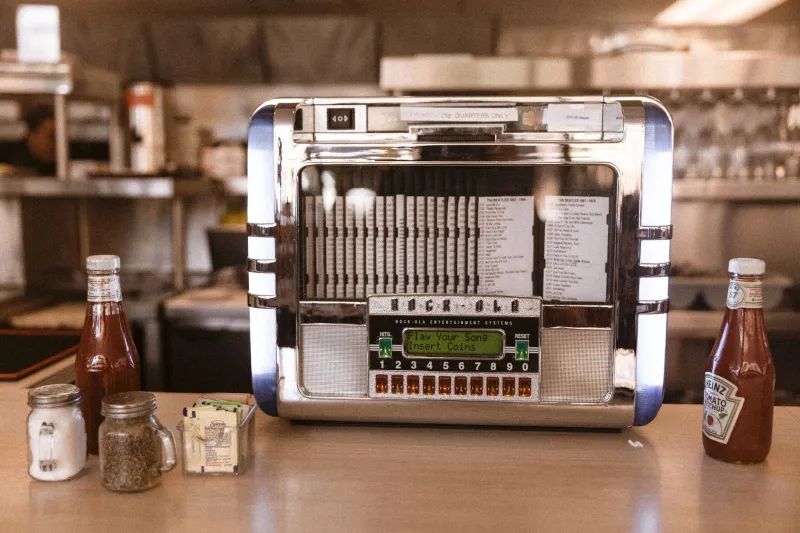
There's a particular kind of silence that settles over a pub when the music is wrong. Not loud-wrong or quiet-wrong. Just wrong. Generic. Chosen by nobody in the room, assembled by a server somewhere that has never tasted a pint or heard a crowd roar at last orders. You know the feeling if you've walked into a pub lately and tried to place the song playing overhead — something inoffensive, mid-tempo, almost deliberately unmemorable. Background furniture. Sonic wallpaper.
It wasn't always like this.
The Machine That Belonged to Everyone
The jukebox was one of the great democratic institutions of British pub life, and we barely noticed it was gone until the silence it left behind became impossible to ignore. For decades — from the post-war Wurlitzers to the digital touchscreen towers of the early 2000s — that machine in the corner operated on a beautifully simple principle: if you cared enough about a song to put your money in, it played. The room decided. Not a landlord, not a licensing executive, not a recommendation engine trained on aggregate listening data. The room.
That mattered more than it sounds. When Dave from the darts team fed in a quid and punched in a Springsteen track, and half the pub groaned and the other half cheered, something social was happening. A statement was being made. A conversation was starting. When someone played Don't You Want Me at 9pm on a Friday and three women at the bar started singing along without looking at each other, a small community was briefly, effortlessly formed. The jukebox wasn't background. It was participation.
And participation, it turns out, is precisely what's been quietly removed from the modern pub experience.
Singalongs Were Never Really About the Singing
Ask anyone who grew up going to proper locals in the 1970s, 80s, or 90s, and the singalong comes up almost immediately. Not karaoke — that's a performance, a spectacle, a thing you watch. The pub singalong was something different. It was accidental and collective, sparked by the right song arriving at the right moment, usually late in the evening when guards were down and the room had loosened into something resembling a genuine community.
Nobody had to be a good singer. That was rather the point. The bloke with the terrible voice bellowing Bohemian Rhapsody from the far end of the bar wasn't embarrassing himself — he was contributing. He was saying: I'm here, I'm part of this, this place is mine too. The singalong was, in its own chaotic way, an act of belonging.
You can't have that moment with a curated playlist. You can't have it when the volume's been turned down to a level that won't disturb the diners, or when the track has been selected to appeal to nobody in particular and therefore offends nobody and moves nobody. The algorithm optimises for inoffensiveness. Community requires the occasional wrong note.
Live Music and the Pubs That Still Understood
Some pubs held on longer than others, and you could usually tell the ones that understood what music was actually for. The function room with a local covers band on a Saturday. The back bar with a folk session on Wednesday evenings. The small stage near the fireplace where a bloke with a guitar played requests until eleven. These weren't sophisticated entertainment offerings. They were permission structures — ways of telling the room that participation was welcome, that tonight was going to be a shared experience rather than a series of parallel ones.
Those pubs tended to be busy. They tended to have regulars. They tended to survive longer than the ones that replaced all of that with a mounted television and a Sonos speaker.
There's a lesson buried in there that the pub industry has been remarkably reluctant to learn.
What the Playlist Replaced
The managed playlist — whether it's a Spotify business account or one of the branded pub music services that now dominate the market — isn't neutral. It makes a specific claim about what a pub is. It says: this is a venue, a commercial space, an environment designed and managed by professionals to deliver a calibrated experience. It says: you are a customer.
The jukebox said something completely different. It said: you are a local. You belong here. Your taste counts.
That distinction sounds trivial until you try to explain why your grandfather's local felt like an extension of his living room and the gastropub three streets away, despite being objectively nicer, somehow never feels like anywhere at all.
The Loss Nobody Filed a Report About
When a pub closes, it makes the news — local paper, maybe a Facebook group campaign, sometimes a small protest outside. When a jukebox gets removed and replaced with a streaming service, nothing happens. Nobody marks it. It doesn't show up in the statistics that the Campaign for Real Ale publishes, or in the government figures about hospitality sector decline. It's invisible.
But it's part of the same story. Every time a pub stripped out something that made it a communal space — the jukebox, the dart board, the lock-in, the singalong — it moved one step further away from the thing it was supposed to be. Not a venue. Not a dining experience. Not a concept.
A living room. The neighbourhood's living room. Noisy, imperfect, occasionally playing the wrong song at the wrong volume, but ours.
Put your money in. Make your choice. That's all it ever took.